

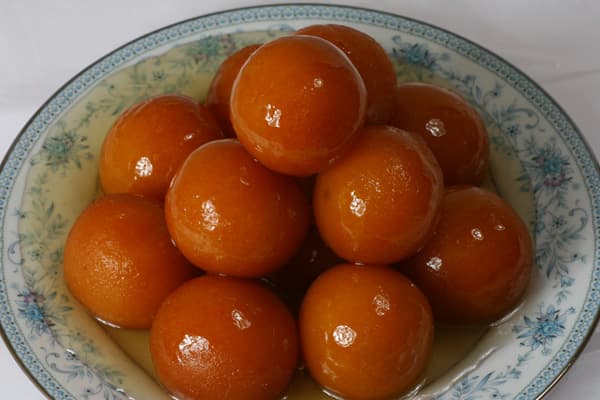
One piece of gulab jamun usually lands between 90 and 150 calories, and 100 grams sits somewhere around 300 to 430. That wide spread is the whole story with this dessert: the size of the ball, how much oil it soaked up in the karahi, and how sweet the chashni was all move the number.
Gulab jamun looks small. That is the trap. A plate of two or three at a wedding or an Eid dinner can quietly add 300 to 400 calories before you have touched the main food. And because they arrive glistening in syrup, most of us count the balls and forget the sugar clinging to them.
What one gulab jamun actually contains
A gulab jamun is a ball of khoya (milk solids) kneaded with a little flour, deep fried in ghee or oil until golden, then soaked in sugar syrup flavored with cardamom, rose water, or saffron. Every one of those steps adds energy. The khoya brings fat and protein, frying adds fat, and the syrup pours on sugar. Homemade versions made with milk powder and light frying sit at the lower end. Shop-bought ones from a mithai wala, fried in bulk and sitting in syrup all day, sit at the higher end.
Here are realistic ranges, built from published nutrition estimates across several food databases.
| Portion | Calories | Protein | Carbs | Fat |
|---|---|---|---|---|
| 1 small piece (about 25 g) | 75 to 110 | 1 to 2 g | 14 to 20 g | 3 to 5 g |
| 1 medium piece (about 40 g) | 120 to 170 | 2 to 3 g | 22 to 30 g | 5 to 8 g |
| 1 large piece (about 50 g) | 150 to 215 | 3 to 4 g | 28 to 38 g | 6 to 10 g |
| 100 g | 300 to 430 | 5 to 8 g | 45 to 60 g | 11 to 16 g |
| 2 medium pieces, warm with syrup | 240 to 340 | 4 to 6 g | 45 to 60 g | 10 to 16 g |
Notice the pattern. The sugar in the syrup drives the carbohydrate number, and most of that is simple sugar. A single large piece can carry 25 grams of sugar or more, which is worth knowing if you are watching your intake.
Why your count and mine never match
Size is the biggest lever. Mithai shops make them in every size, from bite-size mini jamuns served at dhabas to heavy 60-gram balls that could pass for small ladoos. If you log "1 gulab jamun" without noting the size, the estimate can be off by double.
Frying is the second. Balls fried at a low temperature absorb more fat. Balls from a fresh small batch absorb less than ones that have been sitting in the oil through a whole evening of frying. Then there is the syrup itself: a light chashni versus a thick, reduced one can change the sugar per piece by a third. And warm pieces served straight from the pot hold more syrup than cooled ones that have been drained.
This is exactly the kind of food that makes "613 kcal per plate" style precision silly. Two pieces can be 240 calories or 340. Ranges are the honest answer.
Logging it in CalsFlow the right way
Desi sweets are where rough logging usually breaks, so here is how it goes in practice. Type in something like "2 gulab jamun from the mithai shop, medium size". CalsFlow starts with an average assumption, say around 150 calories a piece. Then you adjust. Were they the small dhaba ones or the big wedding ones? Drained or dripping with syrup? Dial the portion and the estimate moves into the right range.
That adjust step is the whole point. A fixed food database can only ever give you the average gulab jamun, and there is no such thing.
A note on sugar
The WHO recommends keeping free sugars below 10% of total energy intake, and ideally lower, because added sugar adds calories without helping you feel full and raises the risk of weight gain and tooth decay over time. One large gulab jamun can deliver close to half of that daily budget on its own.
That does not mean you cannot eat them. It means the dessert table is the place where a small count matters most. People with diabetes should be especially careful: this is a high sugar, high GI dessert, and it is worth talking to a doctor or dietitian about where it fits, or whether a lighter homemade version works better.
Making it work in a normal week
You do not need a spreadsheet to enjoy mithai. A few habits make it easy.
Take one or two and actually enjoy them instead of four eaten out of a box while distracted. If you know dinner will end with dessert, keep the main meal a little lighter, maybe skip the second roti. And when gulab jamun is served warm, let it sit a minute so some syrup drains off. Small thing, real difference.
There are lighter cousins worth knowing. Kala jamun is the darker, slightly drier variant with a chewier crust, and it usually lands in the same calorie ballpark. Mini jamuns, the small ones you find in mixed mithai boxes, are the easiest to portion because one piece is a single bite with a known small size.
If you are comparing desserts across the sweet shelf, the Pakistani food calorie chart puts gulab jamun alongside samosa, halwa puri, and the rest of the usual suspects, and Pakistani chai calories covers the drink that usually arrives next to it.
Frequently asked questions
Is gulab jamun good for weight loss? It is not a weight loss food, but it does not have to wreck a diet either. One or two pieces fit into most days if the rest of the day is on track. The problem is never the single piece; it is the box that keeps giving.
How many calories are in 2 gulab jamuns? Roughly 240 to 340 for two medium pieces, depending on size and how much syrup they are holding. Large shop-bought ones can push two pieces past 400.
Can diabetics eat gulab jamun? It is a high sugar dessert, so the safe answer is: rarely, in small portions, and ideally with your doctor's guidance. A homemade version with less sugar in the syrup is a better occasional option than the shop kind swimming in syrup.
Why does restaurant gulab jamun taste richer? Because it usually is. Commercial batches tend to use more ghee in frying and a heavier syrup, which is exactly why restaurant versions sit at the top of the calorie range.
If you are tracking tonight's dessert, describe it in CalsFlow: the size, how many pieces, and how syrupy they were. Adjust from there and you will have a number you can actually trust.
Cover photo: Gulab jamun by Sapra5379 via Wikimedia Commons (CC BY-SA 4.0). CalsFlow provides nutrition estimates, not medical advice.