

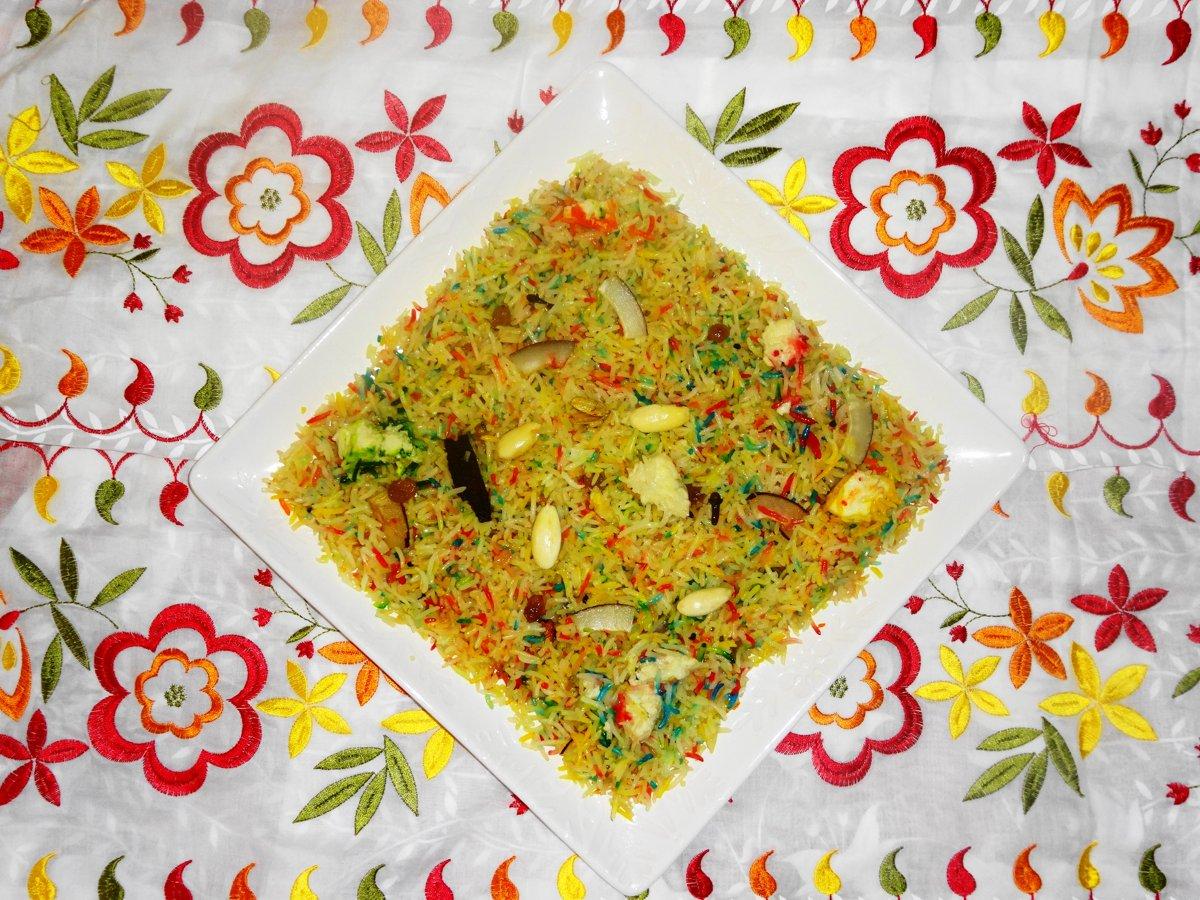
Short answer: one standard bowl of zarda, about 180 g, has 350 to 450 calories. A small tasting portion of about 100 g is 200 to 240. A heaped wedding plate can reach 550 to 700. Zarda is sweet rice, so almost all of its calories come from two things: the sugar it is cooked in and the ghee it is cooked with. Change those two and the number moves a lot.
Zarda, also called meethe chawal, is basmati rice cooked in sugar syrup with ghee, cardamom and saffron or food colouring, then finished with khoya, nuts, raisins and sometimes coconut or ashrafi, those little coloured sugar beads. The name comes from the Persian word zard, meaning yellow. It is a Mughal era dish, and it still shows up wherever a celebration needs a sweet finish: shaadis, Eid, dawats, and the dessert table at a walima. At home it is usually a small bowl after dinner. At a wedding it is a plate, and sometimes a second plate.
Why one bowl can vary by 300 calories
The sugar. This is the main driver. A traditional recipe uses close to equal weights of sugar and dry rice, and most of that sugar stays in the finished dish. USDA FoodData Central lists granulated sugar at about 387 calories per 100 g, so every extra spoonful in the pot is easy to count and hard to hide. A lighter home recipe that cuts the sugar by a third can drop a bowl by 60 to 80 calories without changing anything else.
The ghee. Ghee carries about 900 calories per 100 g, or roughly 120 per tablespoon, and a rich zarda can take several tablespoons for one pot. A recipe made with oil instead of ghee lands in the same place on calories, since oil carries about the same energy per gram. The fat also carries the flavour, so cooks rarely skimp on it at weddings.
The khoya and nuts. Khoya adds richness and a little protein, and it is dense, about 400 calories per 100 g. Almonds and pistachios sit near 580 per 100 g, though a normal garnish is only a small scattering. Raisins are mostly sugar, about 299 per 100 g according to USDA, and a heavy hand with them can add 40 to 60 calories to a bowl.
The portion. This is the one that catches people out. A small bowl at home is one thing. The plate handed to you at a shaadi, with a second spoonful added on top because the host insists, is another. Weigh a bowl once, or count it in cups, and the table below starts to make sense.
Zarda calories and macros
| Portion | Calories | Protein | Carbs | Sugar | Fat |
|---|---|---|---|---|---|
| 100 g | 200 to 240 | 2 to 3 g | 38 to 46 g | 28 to 38 g | 5 to 8 g |
| 1 cup, about 200 g | 400 to 480 | 4 to 6 g | 76 to 92 g | 56 to 76 g | 10 to 16 g |
| 1 standard bowl, about 180 g | 350 to 450 | 4 to 6 g | 68 to 84 g | 50 to 65 g | 9 to 15 g |
| 1 large wedding plate, about 300 g | 550 to 700 | 6 to 9 g | 105 to 130 g | 80 to 105 g | 15 to 24 g |
| 1 bowl, lighter home recipe, about 180 g | 300 to 370 | 4 to 6 g | 55 to 70 g | 30 to 40 g | 10 to 14 g |
The rice is the base. USDA FoodData Central lists cooked long grain white rice at about 130 calories per 100 g, with 2.7 g of protein and 28 g of carbs, and basmati lands in the same place. Plain rice is light. Everything added on top of it, the sugar syrup, the ghee, the khoya, the nuts, is what turns a 130 calorie base into a 200 to 240 calorie dessert.
The sugar in one bowl
A standard bowl carries 50 to 65 g of sugar. That is roughly 200 to 260 calories from sugar alone, and on a 2,000 calorie day it is about 10 to 13 percent of all the energy you eat, in a single dessert. The World Health Organization recommends keeping free sugars below 10 percent of total energy intake, and ideally below 5 percent. One standard bowl of zarda can use up that whole allowance by itself.
That does not make zarda forbidden. It makes it a sometimes food, and it makes the portion the whole decision. A small bowl after a light dinner fits easily into a normal day. A large plate after a full wedding dinner, on top of biryani and naan, is a different story. If you want zarda more often, the home version is where to make it: less sugar, a little less ghee, more nuts and less khoya, and the bowl in the table above drops toward 300 calories.
Zarda vs kheer and gulab jamun
Against kheer, zarda is the heavier dessert. A regular 150 g bowl of kheer runs 170 to 270 calories, while a similar bowl of zarda runs 350 to 450. Kheer gets its calories from milk and sugar, and it carries a little more protein per bowl. Zarda gets its from sugar and ghee, which are denser. If the choice is between the two at a dawat, kheer is the lighter pick.
Against gulab jamun, the comparison depends on how many pieces you eat. One piece is 90 to 150 calories, and two medium pieces with syrup are 240 to 340. That is lighter than a standard bowl of zarda, but three pieces and a bowl of zarda are about even. Gulab jamun is also denser per 100 g, 300 to 430 calories, so a small amount of it goes a long way.
All three are celebration desserts. The honest way to choose between them is to pick the one you actually enjoy, take the smaller portion, and stop at one serving.
The honest way to log zarda
Count the rice in cups, then say how it was made. "One bowl of zarda" is not one number. A light home bowl is about 300 to 370 calories. A rich wedding plate is 550 to 700. The difference is sugar and ghee, and if you log the version you actually ate, the estimate stops lying to you.
In CalsFlow, type:
"1 bowl zarda, wedding style, with khoya and nuts"
You get the estimate with the assumptions spelled out: bowl size, sugar, ghee, garnish. Eating the lighter home version instead? Say so in the entry and watch the number move. Two or three logs and you will know your usual bowl by heart.
Is zarda good for weight loss?
It can fit, as a small portion. A 100 g serving at 200 to 240 calories is a reasonable dessert, and it is far easier to stop at that than at a heaped plate. The problem is the setting. Zarda usually appears after a heavy meal, when you are already full, and the plate is large. A 300 g wedding plate at 550 to 700 calories can wipe out a day's deficit on its own. The NHS suggests aiming for gradual weight loss of about 0.5 to 1 kg a week, which comes from a modest daily deficit rather than a crash. A small bowl of zarda, once in a while, fits that plan. A large plate, every weekend, does not. For more on keeping desi meals inside a target, see how to count calories in Pakistani food and the full Pakistani food calorie chart.
FAQs
How many calories are in 1 bowl of zarda? About 350 to 450 for a standard bowl of roughly 180 g. A small 100 g portion is 200 to 240, and a large wedding plate of about 300 g is 550 to 700.
How many calories are in 100g of zarda? About 200 to 240 calories, with roughly 2 to 3 g of protein, 38 to 46 g of carbs, 28 to 38 g of sugar and 5 to 8 g of fat.
How much sugar is in zarda? A standard bowl carries about 50 to 65 g of sugar. That is close to the World Health Organization's full daily free sugar allowance for a 2,000 calorie diet, in one bowl.
Is zarda healthier than kheer? No, kheer is the lighter dessert. A regular bowl of kheer is 170 to 270 calories against 350 to 450 for zarda, and kheer carries a little more protein from the milk. Zarda is denser because of the sugar syrup and ghee.
Cover photo: Miansari66, Wikimedia Commons, CC0.
CalsFlow provides nutrition estimates, not medical advice.